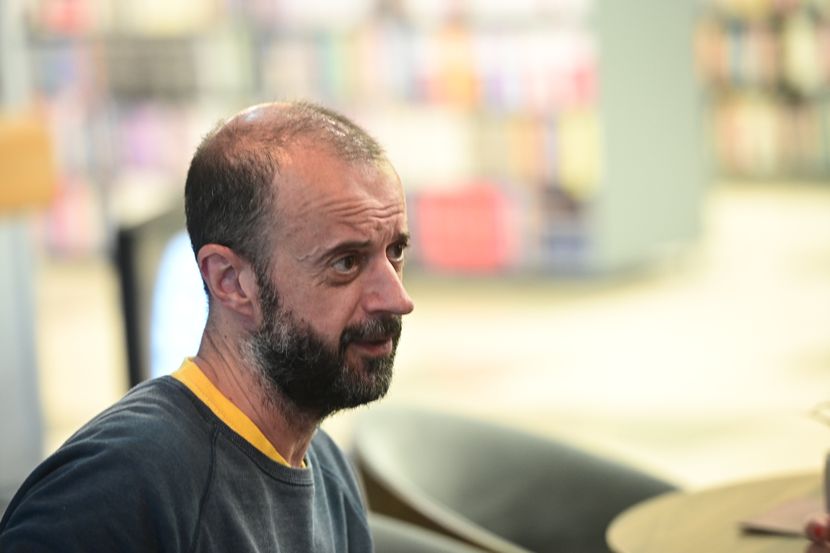
FEST INTERVIEW: Franco Fernando — Creating cinema that moves people to reflect


When you go to the cinema to watch one of his films, don't expect classic entertainment, because the themes he deals with are those that make viewer uncomfortable—like moral dilemmas, deep human relationships, illness, and mental disorders.
Preporučujemo

"Kao da ga je Bog odabrao": Ivana Žigon o Lordanu Zafranoviću, filmu "Zlatni rez '42: Djeca Kozare", FEST -u
Uz "Valcer za pokojne" bend Majke se oprostio od Gorana Bareta: "Hvala ti Bare..."
Franco Fernando is a Spanish director and editor who has an enviable creative oeuvre behind him. In addition to numerous accolades, he won the Goya Award for Best New Director, and the Special Jury Award at the San Sebastián International Film Festival for directing his feature film La herida. He also won the Gaudí Award for Best Editing for his work on the film One Year, One Night
His films make you think, questioning your own values and what lies "Beneath the surface" (Subsuelo)... where we all hope to find "The Light" (Le luz).
Those are the very titles of the two films by Fernando featured in the selection of this year's FEST.
That, among other things, was the reason for this interview.
What makes the family a place of safety, and what makes it a place where the deepest secrets can be hidden like in your movies?
Franco: "It's not such an easy question. I think safety is based on relationships; maybe it's not the family itself that serves as a safe or unsafe place. Safety lies in how people relate to each other. So, I think families could be viewed as institutions—such as the church or schools—where you can find healthy relationships, as well as some that aren't safe at all."
In both of your films, you do not offer the audience simple moral answers. As a creator, do you deliberately avoid passing judgment on your characters?
Franco: "Yes, I don't want to judge my characters. I prefer to place them on screen and allow the audience to draw their own conclusions about their behavior. I'm not a fan of moralizing films or tidy moral conclusions; I prefer films that raise questions, leaving each viewer to answer them in their own way. I don't want to provide a single, absolute answer."
Do you think that audiences today have less patience for films that make them think?
Franco: "Yes. I hope that people who go to the cinema are more patient than those who stay at home watching platforms. For instance, I cannot stand it when people look at their phones while watching a film. As a screenwriter, I deliberately leave certain gaps in the story and the plot to keep the audience engaged. But it is difficult today because people's attention spans are much shorter."
What have you learned about people over the years that you didn't understand at the start of your career and how do you get ideas for the next topics?
Franco: "Usually, ideas come from reading the news or simply staying connected with people. For instance, my third film focuses on a man with cerebral palsy and his intimate life. It was inspired by a young woman I met who had the condition; when she began speaking openly about her sexuality, I realized it was a topic I had completely overlooked. That conversation prompted me to do extensive research and spend time with others in similar situations. Ultimately, staying grounded in reality and listening to people is what sparks my next project."
When you're shooting films or working on scripts, do some of your beliefs change?
"Yes, absolutely. I always say that, to me, writing and the research process are ways of learning. For example, I initially knew nothing about intimacy among people with cerebral palsy. But then I started reading extensively, connecting with people, and that taught me so much. In a way, that happens with every single project I write."
Do you think that movie can change a person?
Franco: I hope so. I think a movie can make you think about something and puts you in touch with realities maybe you don't know. And yes, I think movie is like a book or like a piece of art. I think art in general can give you notions, ideas, learnings, and of course raise questions, that I think is the main thing.
Which movies made you think?
Franco: Which ones? Personally, I think any well-made film should make you think. But if you are looking for specific names from around the world, one director I deeply admire is Kelly Reichardt. She is an American filmmaker who creates beautiful, minimalist films centered on human relationships, and her work always captivates me. There are many others, of course. When it comes to Serbian cinema, I am familiar with Dušan Makavejev, the director of Sweet Movie
But why don't you like to watch your movies?
Franco: Ah, because I spend a lot of time preparing them, with the documentation and writing, through pre-production and shooting, to editing and sound design.
By the time the film is finally finished, it feels abandoned. It’s like letting go of a child; you have to let it live its own life."
"Because you cannot change it anymore. So you abandon the film and say, 'Okay, I think it’s good enough.' Having worked extensively as an editor—cutting more than 50 films in Spain—I’ve had very painful experiences watching them again later, always thinking about how I would have changed this or that. That is exactly why I decided to stop watching my own films."
For your debut film, La herida, you won the Goya Award for Best New Director, and many of your subsequent films have been nominated and awarded worldwide. Do you feel that these awards change the way you approach filmmaking?
Franco: "At the very beginning, when my first film achieved some success in Spain, I thought, 'Okay, this will make it easier for me to make the next one.' But it didn't work out that way. It was incredibly hard to make the second, third, and fourth films. Then, suddenly, the fourth, fifth, and sixth came together in quick succession. So, awards don't really change my approach. I simply try to make what I like and maintain control over my creative decisions. I am very lucky because the producers I work with deeply respect my vision, allowing me to keep final cut privilege. Ultimately, I just focus on moving forward and doing what I love."
How did you manage to have both of your films selected for FEST this year?
Franco: "Honestly, it came down to logistics, as the films are handled by two different sales agents—one in Spain and the other in France. I assume both agencies submitted the films, and the selection committee decided to include them both. La luz (The Light) is my latest project, which was released in Spain just a few months ago, whereas Subsuelo (Subsoil) is an older piece."
Given the sensitive nature of the theme, did you face any obstacles while making La luz?
Franco: "Yes, La luz was a very challenging film to prepare because it addresses internal issues within the Catholic Church, yet we needed to shoot in locations managed by the Church itself. It was a delicate situation because we refused to deceive anyone. We had to find people within the institution who trusted us enough to grant us permission to use certain locations. For other scenes, we used what we call 'desacralizados'—spaces no longer managed by the Church. Naturally, it is hard to get permission to shoot in a cathedral when your film critiques that very institution."
What were the reactions after the film was released
Franco: There were definitely reactions. We organized screenings for victims of child abuse, as well as for representatives of the Catholic Church. Church officials didn’t actually show up in person, but they requested Vimeo links, so we know they watched it. Even the Vatican requested a copy and viewed the film, though they never issued any official response.
Is it true that you rehearsed every single scene before shooting? I read somewhere that you extensively practiced every sequence for La luz—is that accurate?
Franco: "Yes, that’s absolutely true. We dedicated a massive amount of time to preparation. For La luz, we rehearsed for about two or three months, and that was actually on the shorter side. For instance, on Subsuelo, we spent roughly eight months just rehearsing before we started shooting."
Between La luz and Subsuelo, is there one you prefer?
Franco: I don't think anyone has asked me that before. Honestly, I don't have a favorite. I don't have children, but my films are like my children—I love them all equally. There are aspects of Subsuelo I really like, particularly the mise-en-scène and certain visual decisions. With La luz, we intentionally wanted a much more austere film. We deliberately avoided visually beautiful setups because we wanted the absolute focus to remain on the theme and the characters. I am happy with the performances in both, but at the same time, I am never completely satisfied with my work.
And that’s exactly why you don’t watch your own films once they are finished.
Franco: Yes, precisely.
You dedicate a lot of time to your projects. I read somewhere that the casting process took a very long time and you ve seen around 4,000 actors. Did you have anyone specific in mind while writing the scripts?
Franco: Not at all, neither for Subsuelo nor for La luz. The casting process was incredibly difficult because we needed the two leads to convincingly play twins. You can find two phenomenal actors, but if they look completely different or have contrasting accents, it won't work. I was very fortunate because Julia is from the Canary Islands and Diego is from Zaragoza—both regions have very distinct regional accents. However, they were both brilliant enough to neutralize their accents completely. If they hadn't managed that, they wouldn't have been able to share the screen.
Is there an artistic element you are eager to explore today that didn't interest you ten years ago?
Franco: Yes, I’ve become quite obsessed with visual formats and layout.
I’ve been thinking deeply about how to integrate modern communication tools—like cell phones and text messaging—into cinema. In Subsuelo, I wanted to find a way to portray WhatsApp exchanges without resorting to the usual clichés, like basic text pop-ups on screen or close-ups of the phone itself. Instead, I experimented with split screens, juxtaposing vertical and horizontal formats. A few years ago, I wouldn't have given that a second thought, but now it is something that constantly occupies my creative mind
How are you enjoying your time in Belgrade, and what are your impressions of FEST so far?
Franco: I am truly enjoying it. I’ve been walking around a lot and soaking in the atmosphere. FEST is a wonderful, quiet festival—exactly the kind I prefer. There are no pretentious red carpets; it focuses purely on cinema, not the spectacle.
(Telegraf.rs)
Vesti u fokusu
Stigli prvi snimci iz svemira: Sentinel-3C poslao fotografije i podatke posle samo dve nedelje
"Nikad više neću da koristim air fryer": Nova istraživanja zaista otkrivaju o pripremi hrane u njemu
Fotografije "vrele" Australijanke pogledalo preko 6 miliona ljudi, njene noge mnogi su komentarisali
DANAS su Miholjske zadušnice: Svaki drugi Srbin napravi veliki greh, ne iznosite ovo na groblje
Oglasio se Uroš koji je nacrtao Edina Džeka kako se krsti kao pravoslavac: Njegova poruku odjekuje regionom
Video: "Volim Srbiju": Žan-Klod na otvaranju Međunarodnog filmskog festivala u Nišu, obratio se publici
Telegraf.rs zadržava sva prava nad sadržajem. Za preuzimanje sadržaja pogledajte uputstva na stranici Uslovi korišćenja.
Komentari
Priče sa Weba

(FOTO) DEČAK (11) JE UBIJEN UDARCEM U GLAVU, NA ANALIZI JOŠ 50 LOBANJA Naši i svetski naučnici na pragu SENZACIONALNOG OTKRIĆA, saznaćemo i kako je izgledao čuveni vojvoda Stevan Sinđelić
KRVAVI ROĐENDAN U BORČI Slavili rođendan detetu, pa usledio totalni HAOS: Bacio tortu ispred kafane, pa nožem napao bivšeg muža svoje devojke!
VOZAČI, SPREMITE KEŠ! Startuje NOVO PRAVILO vožnje, tiče se svih i košta, a ako se oglušite - kazne od 10.000, pa do čak 800.000 dinara
