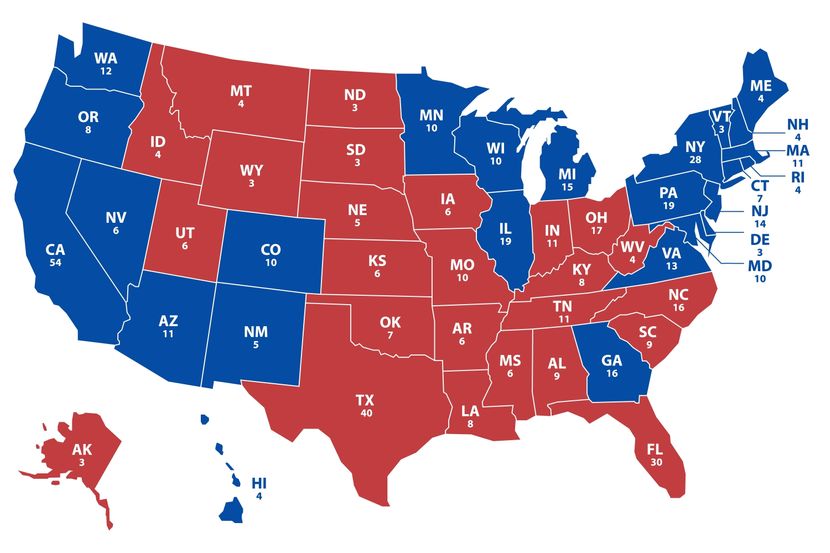
US Elections: What are "swing" states and how they can decide the race? A detailed guide



The US elections, as in previous election cycles, will once again be marked by so-called "swing" states, or undecided states, characterized by the fact that until the last moment it is impossible to determine with certainty which presidential candidate they will vote for.
Kamala Harris and Donald Trump's campaigns this year focused on seven such states, in an effort to convince voters there to cast their votes on November 5th. According to the latest polls, the difference between the two is so small that it can be classified as a statistical error, which is why it will likely be known only on election night which side the swing swings in each of these states.
Recommended

Novak Đoković promenio život jedne žene iz korena, dao joj milion dolara, naljutio se na Jelenu i decu
Njoj uzan plac, njemu velika kuća: Priča o osveti širokoj 1,4 metra koja je prodata za 745.000 dolara
"Swing" states, also known as "battleground states", are those states that can swing towards either Democratic or Republican candidates depending on the election. Because of the possibility of either candidate winning them, political parties often spend a disproportionate amount of time and resources on campaigns in these states.
While there is no universal definition of a swing state, they are characterized by small differences in the vote and changes in which party wins over time. Since 1992, 30 states have voted for the opposing party's candidate at least once in a previous election. Also, 26 states have been won by a margin of less than three percentage points in at lease one presidential election since 1992.
What are the current swing states?
States that voted for incumbent Democratic President Joe Biden in 2020 and former Republican President Donald Trump in 2016 are often referred to as swing states. These states include Arizona, Georgia, Michigan, Pennsylvania, and Wisconsin.
Narrow differences in the vote also indicate that a state could have been won by either party. In the 2020 election, seven states were won by a margin of less than three percentage points. These states include the five mentioned above, as well as North Carolina and Nevada.
Because of the small margin of victory in the 2020 election, these states could have even tighter outcomes in the upcoming congressional elections.
Which states have historically been "swing" states?
Political realignment from presidential election to presidential election - such as the shift from Trump to Biden - can be one way to identify "swing" states. Years in which a president is running for reelection tend to have fewer states that switch sides, but since 1992, every presidential election has had at least a few states that changed political affiliation.
Of the past eight presidential elections, the 1992 election had the highest number of states that changed political party affiliation. With 22 states that changed hands from the previous election, it is often cited as a year of political realignment, with Bill Clinton's victory over George H. W. Bush turning many traditionally Republican states (including California, Colorado, Maryland, among others) into states that would reliably vote Democratic for the next decade.
There has not been a presidential election since 1992 with so many states voting for a candidate of the opposite political party.
However, many states have had close presidential elections in the past 40 years. Over the past eight presidential elections, 26 states have been won by margins of less than three percentage points in at least one election. This includes Florida and Nevada, which have had narrow margins in five of the past eight elections.
These "swing" states have also changed over time. For example, New Mexico and Iowa were swing states in 2000 and 2004, but have not since. Arizona and Georgia have alternated as swing states for the past two decades.
Which states consistently vote for one political party?
Since the 1988 election, 20 states and Washington, D.C., have voted for the same party in every presidential election. Of those 20 states, only three - Minnesota in 2016 and 2000, Oregon in 2000, and Washington D.C. in 1988 - have had close elections decided by a narrow margin.
Seven states and Washington, D.C. have consistently voted for the Democratic presidential candidate since 1988, and 13 states have consistently voted for the Republican presidential candidate. Although there was speculation that Texas would become a swing state in 2020, the difference between the Republican and Democratic votes remained at 5.5 percentage points.
An additional eight states changed political orientation from 1988 to 1992, but have voted for the same party in every election since then.
Which states are most likely to vote for the winner of a presidential election?
"Swing" states also tend to be better predictors of the eventual winner of an election. Although Florida was a swing state in the 2000 election, several other states have also been reliable predictors of the final election results. Over the past nine elections, Nevada and Ohio have "predicted" the final election result eight times.
Since 2000, five states - Colorado, Florida, Nevada, Ohio, and Virginia - have matched the eventual winner of an election in all but one election.
(Telegraf.rs)
news_in_focus
Sneg će padati bez prestanka, otkrivamo i do kada: Grmljavina, vejavica i do 30 centimetara belog pokrivača!
Ulje se sipa u vruć ili hladan tiganj? Da razjasnimo jednom zauvek
Skidajte to sa kreveta i odmah bacajte iz spavaće sobe: 5 boja posteljine zbog kojih kuća izgleda staromodno
Travka sa crnogorskih planina potapana u rakiju da bi je pili kao MUŠKI ČAJ: Pomaže stomaku, ali ne i monasima
Kuglice od sira u tri boje: Od jedne smese napravite predjelo koje ulepšava slavsku trpezu
Video: Ulice Tirane posle protesta koji je prekinula kiša
Telegraf.rs zadržava sva prava nad sadržajem. Za preuzimanje sadržaja pogledajte uputstva na stranici Uslovi korišćenja.
Comments
Web stories

U TOKU VELIKA AKCIJA HAPŠENJA U NOVOM SADU! Na udaru lica koja su planirala napade i nemire 25. oktobra
(MAPA NEMIRA) ERUPCIJA BESA RAZARA EVROPU Evo gde sve bukte neredi i kako je krenuo talas protesta zbog kog Tramp zove na ZATVARANJE GRANICA
ZELENSKI PREDAJE PUTINU DEO UKRAJINE?! Šokantna vest uzdrmala svet: Pristao na BOLAN USLOV zarad mira, traži garancije od Evrope i Trampa (VIDEO)
