Economic price of hell NATO inflicted on Serbia: Economy set back 100 years, damages measured in billions


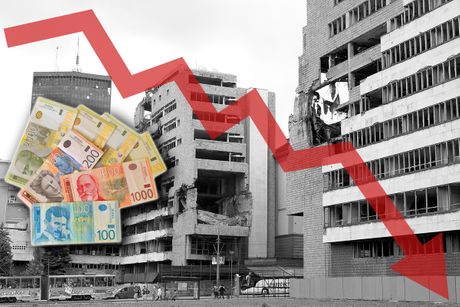
Today, March 24, marks exactly 27 years since the moment the first air raid sirens sounded across Serbia, announcing the beginning of the NATO aggression against the Federal Republic of Yugoslavia (SRJ, Serbia and Montenegro). While this day is always primarily spent remembering the immeasurable loss that are the people who perished, the economic outcome of the 78 days of bombing continues to affect the foundations of Serbia's economy to this day.
Recommended

Ključa na granici Severne Makedonije i Albanije: Skinuta makedonska zastava na Korabu i stavljen dvoglavi orao
Niko više ne želi plafonjeru u kuhinji, sad svi ovo traže: Izgleda skuplje i mnogo je praktičnije
To arrive at a number that expresses the damage is a challenge even after almost three decades, because the directly destroyed assets are only the tip of the iceberg. The real losses are hidden in indirect factors, the damaged political standing and the permanent losses suffered by the country's development potential.
Lost potential
According to domestic experts, such as Ivan Nikolic from the Economic Institute, the state has never formally made a single calculation of all the losses. However, various studies conducted since 2000 provide a clearer picture:
Direct losses have been estimated at between 4 and 5 billion dollars. Indirect and induced losses: According to G17 estimates released in 2000, these reached 40 billion dollars, while the Economic Institute at the time presented the results of its analysis that put the figure at 50 billion dollars.
Maximum estimates: Analysts like Nikolic and Bojan Stanic arrived at 100 and even up to 300 billion dollars in economic damage, taking into account permanently lost potential.
Nikolic emphasizes that the media narrative abroad created to justify bombing Serbia also negatively impacted the economy, labeling the country as an environment in which "no normal person would do business".
Economy set back a century
Industrial production figures best illustrate the scale of the disaster. In May 1999, a historical minimum was recorded: Average production output was lower by 25.6 percent compared to the previous year.
"At that time, the level of the physical volume of industrial production was 5 percent lower than the minimum recorded in January 1994, at the peak of the hyperinflation. Compared to January 1989, when the transition formally started, the level in May 1999 was lower by 81.6 percent. It was truly catastrophic, it was the rock bottom, and from that moment Serbia was set back a century," Nikolic previously told Tanjug.
Infrastructural collapse and loss of resources
Analyst Bojan Stanic recalls that the economy was already "stunned" by the sanctions imposed against Serbia from 1992 until 1995. Although there was a slight recovery in the late 1990s, the bombing brought a sharp drop in GDP - minus 18 percent.
The focus of the aggression on targeting Serbia's infrastructure left lasting scars.
The Construction Directorate of Serbia (2006) listed 54 destroyed road infrastructure structures (including 44 bridges) and 18 railway infrastructure structures.
148 high-rise buildings (residential and public) came under attack.
Stanic says another direct consequence is that Serbia was cut off from its natural, agricultural and industrial resources in the territory of Kosovo and Metohija, which, along with the subsequent change in relations with Montenegro, had profound impact.
As many years had to pass for Serbia to achieve stability and start attracting larger-scale foreign investments, experts agree that 1999 "cemented" an overall disastrous decade for the economy.
The lost human capital and decades of efforts to bring the country back into the world's economic mainstream remain a reminder of the price the economy paid during the 78 days of the NATO bombing, that spanned the spring of 1999.
(Telegraf Biznis)
news_in_focus
Albanija doživela poraz kakav se ne pamti, dva gola o kojima priča Evropa
NAJTAČNIJI NEDELJNI HOROSKOP: Vage konačno vraćaju dug, Lavovi neka uspore dok ne bude kasno!
"Neko ko dolazi s Kosova..." Slovenački premijer Janša poslao oštru poruku Albancima sa KiM
Ovo je mladi pecaroš Petar koji je poginuo na jezeru kod Barajeva
NASLOVNE STRANE DANAŠNJIH NOVINA: Prelistavanje štampe za nedelju, 4. oktobar 2026. godine
Video: Posebna ponuda kupcima stanova u Beogradu na vodi
Telegraf.rs zadržava sva prava nad sadržajem. Za preuzimanje sadržaja pogledajte uputstva na stranici Uslovi korišćenja.
Comments
Web stories

ODAKLE JE NEKO KO NA TABLICI IMA "KC" Važi za najmanje mesto koje ima svoju registarsku oznaku
Policija u zabačenoj ulici u Novom Pazaru primetila sumnjivu devojčicu (16), sekund kasnije otkriven je UŽAS! Dete žrtva trgovine ljudima, uhapšena NJENA MAJKA!
UBIO SVEKRA SVOJE ĆERKE JER JU JE SILOVAO?! Jezivi detalji porodičnog zločina kod Bačke Palanke: Ušao mu u kuću i TUKAO GA ŠIPKOM
