
Unexpected capital of American power: The city where you can't get lost has one brilliant rule!


Passport, money, brains… And, of course, the American visa. Everything is ready for a nearly 20-hour-long journey to the capital of the United States of America. When I boarded the behemoth in Frankfurt that would ‘take me across the pond’, I didn’t know what awaited me on the other side. People had told me that Washington is a city that does not show its power through skyscrapers but through magnificent monuments, and they advised me to pack comfortable shoes because I would be walking like crazy, eager to explore every corner of the city.
I realize just how right they were as the plane approaches Washington Dulles Airport. Instinctively, I look for the silhouettes of skyscrapers, but there are none. Instead of glass towers, I see a sea of greenery and wide avenues... Only here and there, above the treetops, the pointed tip of the Washington Monument and the white dome of the Capitol emerge. If it weren't for those famous symbols, I would think I hadn't crossed the ocean, because what lies below looks like some European city…
Recommended

Porodila se Silvija Nedeljković posle 17 godina borbe za potomstvo: Na svet stigli blizanci
NASLOVNE STRANE SUTRAŠNJIH NOVINA: Prelistavanje štampe za utorak, 22. septembar 2026. godine
Although tired from the exceedingly long trip, thrilled, I hand over my papers to the lady at passport control. She looks at the visa, looks at me, and then asks the usual – why are you here, how long are you staying, where are you staying… After the formalities are finished, I run to overcome my biggest fear – did my suitcase arrive. It's there; getting to know America can begin.
A city where you navigate without a map
Straight from the airport, we merge onto the highway. Mostly new vehicles, largely Japanese, an occasional BMW zooms by, a Tesla here and there, and a few Fords. Surreal greenery all around. Although we are getting closer to the center, there are still no skyscrapers, but the reason for this panorama is no coincidence. The maximum height of a building is regulated by law. While urban legend says that regulations do not allow anything to surpass the Capitol and the Obelisk, the truth is a bit more pragmatic - the law actually dictates that a building cannot be taller than the width of the street it faces, with an allowed addition of about six meters.

That is probably why you are immediately delighted by every part of the city you pass through. Your gaze is drawn to surreally beautiful red-brick houses, some as much as 200 years old. Here and there, a more modern multi-story building has sprung up, but nothing ruins that vintage look. The yards are full of flowers, the sidewalks are paved with dark red brick and so nicely tucked into the shade of the canopies of century-old trees that you simply don't want to get back into the car. The view of the open sky stretches everywhere, giving an incredible feeling of freedom. There are no massive buildings to suffocate you, the wind blows rather nicely, just enough to at least slightly ease the crazy summer heat.
As we drop off in front of the hotel, a glance at the street name sign clearly shows how far we are from the heart of the city. Namely, the streets in Washington are organized with almost mathematical precision. Those running north-south are mostly numbered - First, Second, Third… Those stretching east-west carry the letters of the alphabet. Diagonal avenues are named after American states, like Pennsylvania or Massachusetts, and it is precisely these that intersect the regular grid of streets, creating squares and roundabouts. Addresses tell you exactly where you are, because the number or letter indicates how many blocks you are away from the Capitol - the city's ground zero. Once you understand that system, you almost don't even need a map anymore.
The first sightseeing spot, at least in my case, was the Kennedy Center. The white marble building, erected on the banks of the Potomac, looks almost austere. There are no lavish domes or attention-grabbing sculptures. Only when you enter through the massive doors do you realize the grandeur of this place. The red carpet stretches almost endlessly. In the Hall of Nations, at a dizzying height, hang the flags of countries with which the USA has diplomatic relations - yes, our tricolor is there too. In the Hall of States, the flags of all 50 American states and territories flutter.
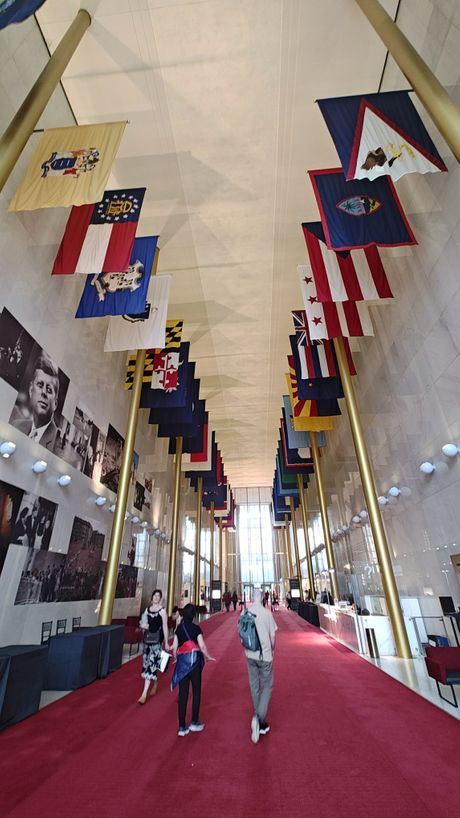
The Grand Foyer, one of the longest in the world, is a story in itself. Walls of white Italian marble, gilded columns, giant crystal chandeliers, and a glass wall facing the Potomac River create the impression that you are in a special palace, exclusively dedicated to art. Over three thousand plays, concerts, operas, and ballets take place here annually, attended by several million visitors. It's surreal to walk the foyer where Pavarotti, Plácido Domingo, Itzhak Perlman, Ella Fitzgerald once passed...
And while on evenings when opera or ballet are on the repertoire, you will see people in glamorous gowns here, on other days you will see completely ordinary folks. They come from all over because Washington strives to make culture accessible to everyone, so there are free minibuses that transport anyone who wants to visit the Kennedy Center or attend one of the free concerts and performances organized here several times a week from almost every metro station.
Although you will hear the roar of airplanes flying overhead on their way to or from the Ronald Reagan Airport in the foyer, it's interesting that you cannot hear them when you are inside the halls. Architects ensured that nothing disrupts the audience's enjoyment, so each is built like a "box within a box," and the halls have their own outer walls and a special structure that absorbs vibrations and sound.
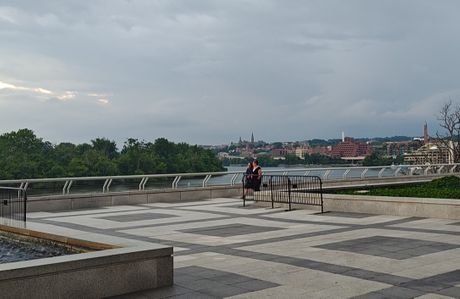
But perhaps the most beautiful part of the Kennedy Center is not in the halls at all, but on the terraces. One is accessed from the foyer, and an elevator takes you to the one on the roof. Both offer one of the most beautiful views of Washington. On one side, you can see the Potomac River over which airplanes glide toward the runway, while on the other rise the Lincoln Memorial, the Washington Monument, and the famous Capitol.
The power of white marble
No matter how enchanting the Kennedy Center is, nothing can prepare you for the beauty of the National Mall and Memorial Parks – a 1,000-hectare green oasis connecting the Capitol with the riverbank. It looks like a giant open stage of American history. Perfectly manicured lawns, paths full of tourists, families, and schoolchildren, all guarded like a stone sentinel by the Washington Monument.
The white marble obelisk, nearly 170 meters tall, looks simple, almost modest. When it was completed in 1884, it was the tallest structure in the world, but now it is better known for the fact that about a third of its height has a different stone color. Construction was, in fact, halted for over twenty years due to a lack of funds and political conflicts, so the obelisk was ‘added onto’ with marble from a different quarry. That "scar" remained visible forever and today represents one of the most interesting details that tour guides gladly point out.
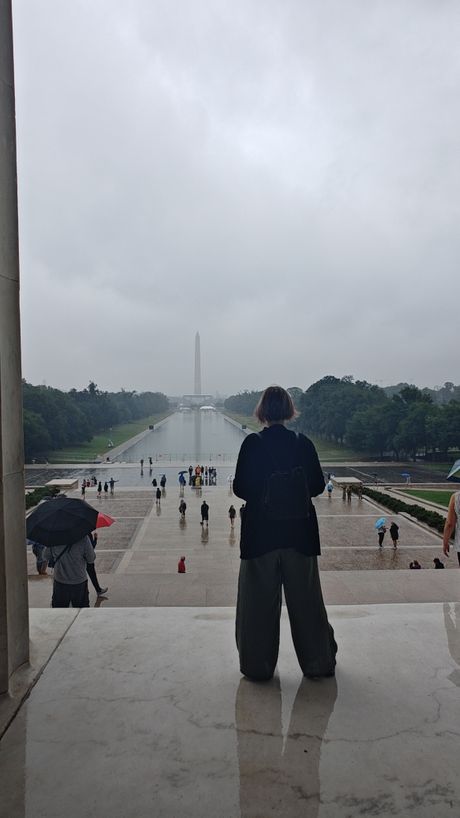
West of the obelisk stretches a long ‘mirror of water’. The Reflecting Pool connects two symbols of American history - the monument to the president who preserved the Union and the obelisk erected in honor of George Washington. Until recently, at least, the sky, clouds, and monuments were reflected in the pool's water, creating one of the most famous photographs of Washington. However, a recent coating of the bottom with a special blue paint did not yield the desired effect, so I find green water with no reflection, and fences prevented me from walking around the 650-meter-long and 50-meter-wide pool and visiting the World War II Memorial - fifty-six granite pillars arranged in a circle representing the American states and territories that participated in the war.
Therefore, I direct all my attention to the Lincoln Memorial. As I stand at the bottom of the stairs, I don't get the impression that I will climb up to a monument that has stood here for more than a century. It looks more like an ancient temple. Wide stairs lead toward a colonnade of 36 massive Doric columns, one for each state that existed at the time of Lincoln's death in 1865, and above it all dominates a simple white stone facade. Architect Henry Bacon did not choose the look of a Greek temple by chance. The idea was that Lincoln should not be presented merely as one of the American presidents, but as a statesman whose decisions are connected to universal ideas of freedom and unity.
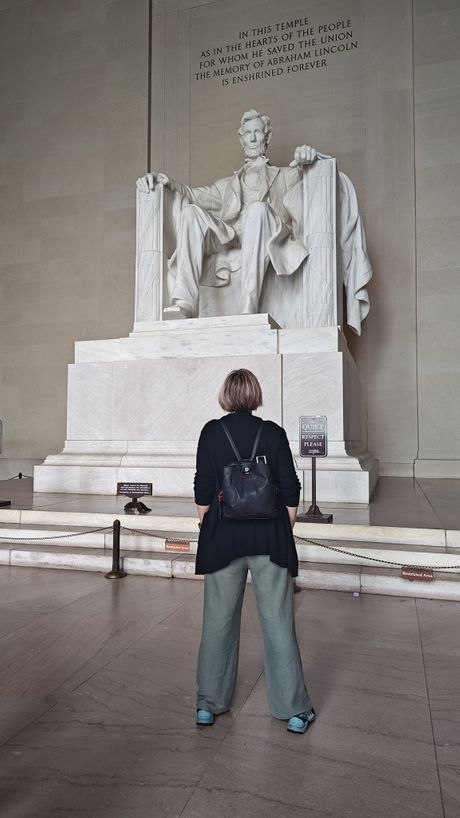
But the true power of this place is revealed only when you step inside. In the twilight of the central chamber sits Abraham Lincoln, carved from Georgia marble. He is almost 6 meters tall, deep in thought, with his hands resting on the arms of the chair. He lacks the triumphant expression of a military commander. He looks serious, almost tired, as if immortalized in the moment he bore the burden of the decision to lead the nation through the bloodiest conflict in its history.
While observing the marble giant, I recall interesting legends related to this monument. One is about the position of the hands. Many believe that the artist hid the letter "A" in the fingers of the left hand and an "L" in the right - Lincoln's initials, which has not been historically confirmed. Another concerns the head itself. In the carved waves of his hair, some claim to recognize the profile of Robert E. Lee, the Confederate general who was on the opposing side during the Civil War. The story is fueled by the fact that across the Potomac River, on the green hill of Arlington, lies the former home of General Lee. It turns out that the marble Lincoln has his back forever turned to the man whose army tried to tear down the country he defended. Even though I looked closely, I didn't see the profile, and historians also say there is no hidden message in the hair and that the supposed profile of Lee is just a trick of light, shadow, and the observer's imagination.
I may lack imagination, but not curiosity, so on one side I read the carved words of the Gettysburg Address about a new birth of freedom, which he delivered in 1863 at a military cemetery in Pennsylvania. On the other side is the Second Inaugural Address from 1865, spoken near the end of the Civil War. Behind the statue itself is an inscription explaining the purpose of the entire place: that the memory of Lincoln be enshrined forever in the hearts of the people for whom he saved the Union. For me, however, the view from the top of the stairs toward the obelisk and the plaque on the plateau engraved with the name of Martin Luther King will remain forever etched in my memory. It was right there that he stood while giving his famous "I Have a Dream" speech in 1963 in front of more than 250,000 people.
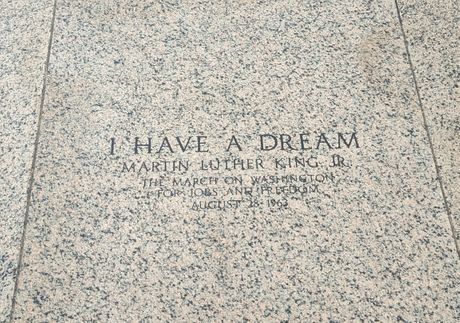
Not far from there is the Vietnam Veterans Memorial, a monument engraved with the names of more than 58,000 American soldiers killed or missing in the war, as well as the Korean War Veterans Memorial.
However, what left by far the biggest impression on me is the monument located on the south side of the Mall. A circular structure on the shore of a lake, with a white dome reminiscent of some ancient temple. The monument is dedicated to Thomas Jefferson, the third US president, the principal author of the Declaration of Independence from 1776, and one of the most influential thinkers among the American founders.
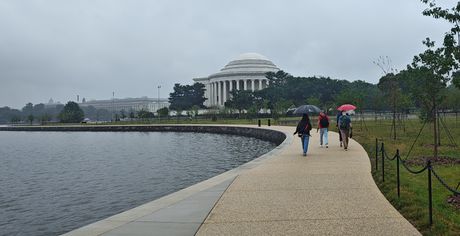
The memorial was opened in 1943 - symbolically, at a time when the battle over the issues of freedom and democracy was being fought again. Interestingly, it was built almost right next to thousands of Japanese cherry trees, which Tokyo gifted to Washington in 1912 as a symbol of friendship between Japan and the USA. They say the memorial looks surreal in the spring when the cherry blossoms are in bloom.
Inside the circular hall is a bronze statue of Jefferson, almost six meters tall. Unlike the pensive seated Lincoln, Jefferson is depicted standing upright, document in hand, as a man of ideas and words. His gaze is directed toward the White House, nearly a kilometer away, as a reminder of the connection between political philosophy and executive power.
Carved into the interior walls are excerpts from his most famous texts. The most important is the part of the Declaration of Independence, featuring the sentence that became one of the foundations of the American political identity - that “all men are created equal” and that they have unalienable rights, among which are life, liberty, and the pursuit of happiness.
While America today, in the spirit of the great "Freedom 250" jubilee, proudly celebrates two and a half centuries of these visionary words, you realize that the construction of that freedom was not just one historical moment, but a long journey. The sentence carved into the Jefferson Memorial was for centuries the highest ideal and the guiding star the country constantly strived for. You become very aware of how powerful that aspiration is when, just a few minutes' walk away, you see the monument to the man who took up that historical baton and helped bring the old promise from the Declaration to life. This is the monument to Martin Luther King, a man who did not demand new rights, but did everything to ensure America fully realized that dream it promised itself 250 years ago.
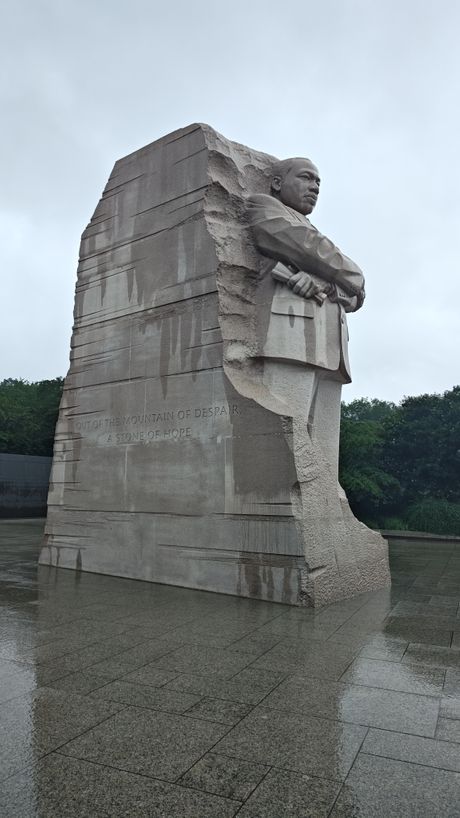
The monument was unveiled in 2011 and visually stands out from all the others. There are no tall columns, no figures on pedestals… The entrance leads through the Mountain of Despair, a passage between two large pieces of granite. When you pass through it, the Stone of Hope emerges, bearing the carved image of Martin Luther King.
King's figure is about nine meters tall and depicts him with crossed arms, looking seriously toward the Lincoln Memorial, the place where he delivered the speech that made him one of the most famous figures in the civil rights struggle. Along the walls of the memorial is the so-called “Inscription Wall”, where excerpts from King's speeches and sermons are inscribed. These speak not only of racial equality, but also of poverty, war, peace, and the individual's responsibility to society.
All roads lead to the White House
From the marble in which the ideas of freedom and equality are carved, the path leads to the place where those ideas are daily transformed into political decisions. A few minutes' drive from the Tidal Basin is the most famous address in America – the White House, the home and workplace of the President of the United States of America.
Of course, this had to be a special stop, but after that feeling of vast expanse and grandiose, open monuments, a rather large shock ensued. The encounter with the White House seemed like a collision with the harsh reality of the modern era – what with recent breach attempts and the preparations for the Independence Day parade, the residence of America's leading man looked more like an impenetrable fortress. It was surrounded by a black fence, so densely intertwined that on a photograph you can barely make out what is in the background.
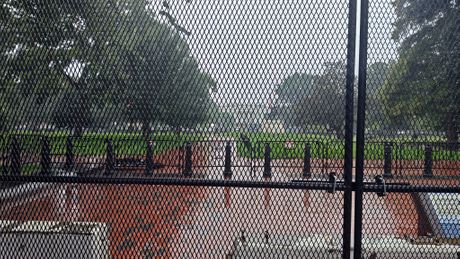
Still, that lack of visual freedom did not deter hundreds of tourists from pushing minute by minute to grab the best possible position for a picture… I didn't want to push with them, the streets carried me further, all the way to Dupont, Georgetown, and numerous other wonderful locations in Washington that you simply must not skip once you've visited the “symbols of the city”. About those other locations, which I visited thanks to the program of the US Embassy in Serbia, and which include the famous Smithsonian museums, the Library of Congress, and the birthplace of George Washington, I will write to you in one of my future reportages…
Until then, keep in mind one incredible contrast: although this is the most important city in the United States of America, the epicenter of global political power where all key state institutions are located, Washington is actually a city of water, greenery, and some unexpectedly peaceful, almost slowed-down energy.
You expect cold bureaucracy and the hustle and bustle of a metropolis, and instead, you are welcomed by a somewhat relaxed atmosphere and many nice people. It felt completely safe to me, so I walked freely late into the night, but by all means, always be on your guard.
Useful tips before you pack your bags
- Water is a must: Wherever you go, always carry a small bottle that you will be able to refill at almost every step.
- Prepare your budget: Always carry at least three times as much money as you would bring for a night out in Serbia, because prices in supermarkets, cafes, and fast-food restaurants are significantly higher. Never carry large amounts of cash with you!
- Caution with the local "residents": Do not approach the squirrels under any circumstances! No matter how friendly they seem, they can bite if they feel threatened.
- Rules for smokers: Prepare to be looked at with disapproval, and in some places even asked to leave if you light up a cigarette in an open space.
- Surreal cleanliness: Throw all tissues, used chewing gum, and cigarette butts into the trash cans that are placed every 20 meters. You will simply feel uncomfortable throwing anything outside of them because the streets are "crazily" clean.
(Telegraf.rs)
news_in_focus
Posle jednokratne pomoći, penzionerima stiže nova uplata pre decembarskog povećanja: Evo i kada
Spremite se, pomeramo sat: Evo kog datuma vraćamo kazaljke i dobijamo sat vremena više
Da li znate koja je najmanja dozvoljena brzina na auto-putevima u Srbiji?
Evo ko će 6.000 dinara pomoći dobiti prvi, a ko mora da sačeka do petka
Žena Darka Lazića sinoć uletela pod šator na šabačkom vašaru, pa napravila "incident": Otela mu mikrofon
Video: U Beogradu odigrana Uspavana lepotica u izvedbi umetnika Boljšoj i drugih ruskih teatara
Telegraf.rs zadržava sva prava nad sadržajem. Za preuzimanje sadržaja pogledajte uputstva na stranici Uslovi korišćenja.
Comments
Web stories

ISTORIJSKI PORAZ, OVO SE NIKADA NIJE DESILO! Stigli prvi rezultati pokrajinskih izbora u Nemačkoj: Ekstremna desnica počistila sve, Mercova stranka LETI IZ PARLAMENTA!
ČAČAK ZAVIJEN U CRNO! Umro Mladen Vujačić, heroj Civilne zaštite grada: "Pomagao je svima, kad god je trebalo"
IZREŠETAO BRATA SA 7 HITACA, PA POBEGAO SA LICA MESTA?! Otkriveni detalji stravičnog ubistva: Svemu prethodila svađa, policija pretresla kuću u Tuzli
